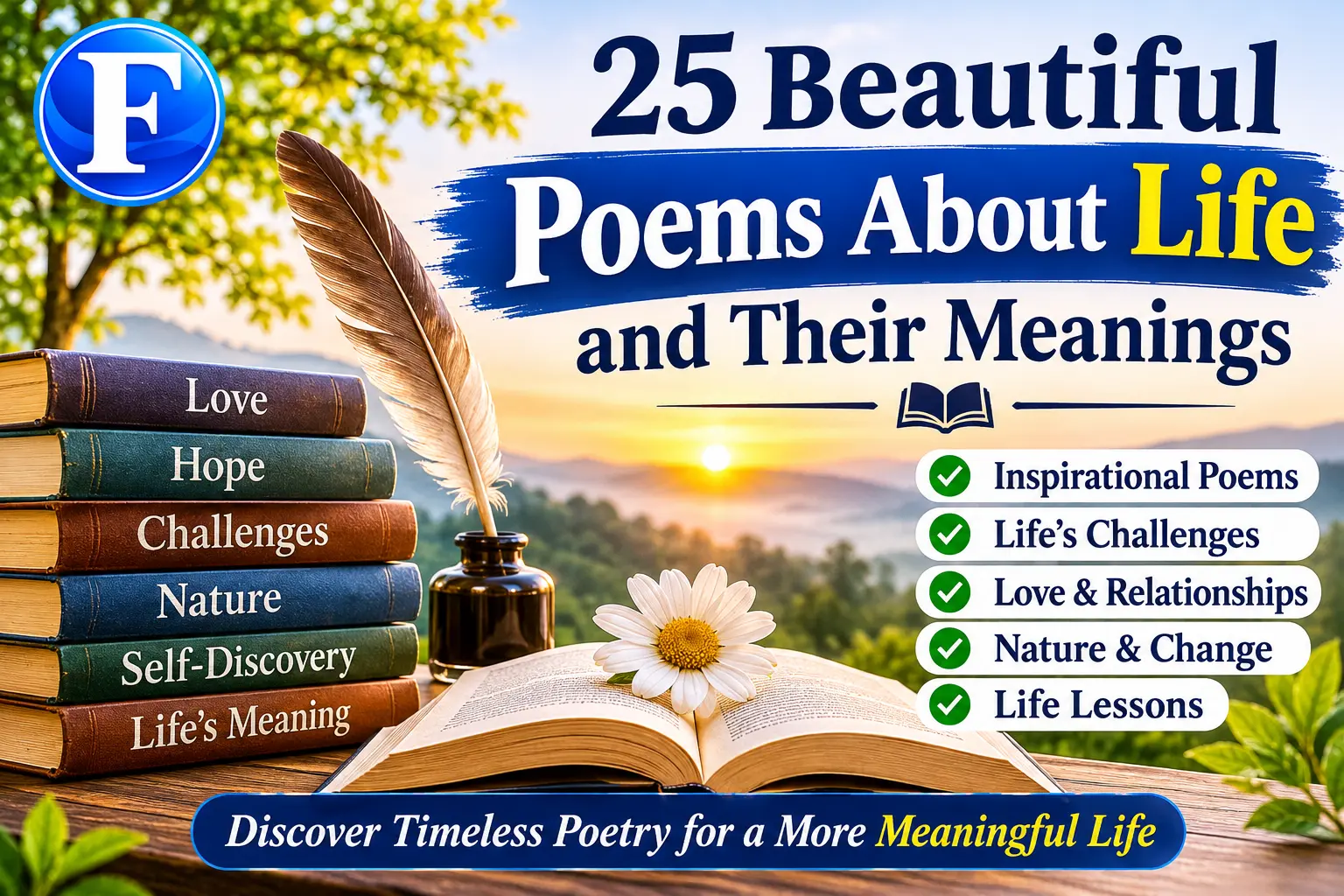
Poems about life offer a meaningful way to understand the experiences, emotions, and choices that shape our journey. From moments of happiness and hope to periods of uncertainty and personal struggle, poetry helps us explore what it means to be human. Whether you are looking for inspiration, comfort, or a fresh perspective, a thoughtful poem can encourage reflection and self-discovery.
Throughout literary history, poets have explored themes such as love, personal growth, resilience, nature, identity, and the passage of time. Their writing offers different ways to understand life’s challenges and appreciate its meaningful moments.
In this collection, you will discover 25 beautiful poems by well-known poets, along with explanations of their themes and interpretations of the lessons they offer. Each selection provides a different perspective on human experiences and the search for meaning.
Inspirational Poems About Life
Inspirational poetry reminds us that life is worth experiencing, even when the journey becomes difficult. These poems explore hope, courage, perseverance, and the importance of maintaining a positive outlook.
1. A Psalm of Life – Henry Wadsworth Longfellow
Henry Wadsworth Longfellow’s A Psalm of Life is one of the best-known inspirational poems about life. It challenges the idea that human existence is meaningless or that people should simply wait for the future to arrive.
The poem encourages readers to use their time meaningfully and leave a positive influence through their actions. Its central message emphasizes purpose, courage, and determination rather than allowing life to pass without meaningful effort.
Life lesson: Your actions matter. Instead of spending all your time thinking about the past or worrying about the future, focus on making your present meaningful.
2. If— – Rudyard Kipling
Rudyard Kipling’s If— presents a thoughtful picture of maturity, discipline, and self-control. Through a series of challenging situations, the poem explores qualities such as patience, honesty, confidence, and emotional balance.
It suggests that personal strength is not simply about winning or receiving recognition. It also involves remaining calm during difficult circumstances and treating both success and failure with perspective.
Life lesson: True character becomes visible when circumstances are challenging. Patience, discipline, and integrity can help guide better decisions.
3. Still I Rise – Maya Angelou
Maya Angelou’s Still I Rise is a powerful poem about resilience, dignity, and personal freedom. It expresses the determination to remain confident despite prejudice, criticism, and attempts to diminish someone’s identity.
The poem is particularly meaningful because it connects personal strength with the wider history and experiences of Black people. Its message reaches beyond individual struggles and celebrates the ability to stand with pride and confidence.
Life lesson: Other people’s judgments do not define your identity or determine your worth.
4. Hope Is the Thing with Feathers – Emily Dickinson
In Hope Is the Thing with Feathers, Emily Dickinson uses the image of a small bird to represent hope. The bird continues singing even during difficult conditions, creating a gentle picture of hope as something that remains present through uncertainty.
The poem does not suggest that life will always be easy. Instead, it explores how hope can provide emotional strength when circumstances become uncomfortable or unpredictable.
Life lesson: Hope can help you move through difficult moments, even when you cannot immediately see a solution.
5. O Me! O Life! – Walt Whitman
Walt Whitman’s O Me! O Life! explores questions about human existence, purpose, and the meaning of everyday experiences.
The speaker reflects on disappointment, repeated struggles, and the feeling of searching for something meaningful. The poem eventually turns toward the idea that life itself offers an opportunity to contribute. Every person has a role in the world, and individual experiences can become part of something larger.
Life lesson: You do not need to have every answer about life. Your experiences and contributions can still give your journey meaning.
Poems About Life’s Challenges and Struggles
Life is not always predictable. Personal struggles, uncertainty, disappointment, and difficult decisions are part of the human experience. These poems explore how people respond to challenges and search for meaning during complicated times.
6. The Road Not Taken – Robert Frost
Robert Frost’s The Road Not Taken uses the image of two roads in a forest to explore choices and their influence on life. The speaker must decide which direction to follow, knowing that choosing one path means leaving the other behind.
The poem is often interpreted as a celebration of independent decisions. However, its meaning is more complex than simply choosing an unusual path. Both roads are described as quite similar, and the speaker reflects on how people later give meaning to their decisions.
This makes the poem an interesting exploration of memory, choice, and how people interpret their personal journeys.
Life lesson: Every decision shapes your experiences, but the meaning of a choice is not always clear when you make it.
7. Life Is Fine – Langston Hughes
Langston Hughes’s Life Is Fine explores emotional struggle through a distinctive blend of blues rhythm, repetition, and dark humor.
The poem’s speaker moves through intense disappointment before returning to an appreciation of life. Rather than presenting happiness as something permanent, Hughes shows how complicated human emotions can be.
Its changing tone makes it a memorable reflection on resilience and the ability to find a different perspective during difficult experiences.
Life lesson: Emotions can change, and a difficult period does not have to define your entire life.
8. The Dark Night of the Soul – St. John of the Cross
The Dark Night of the Soul is a spiritual poem by St. John of the Cross, a sixteenth-century Spanish poet and religious writer. It explores the soul’s journey toward union with God through a period of spiritual purification and transformation.
The darkness in the poem is not simply a symbol of ordinary sadness or everyday problems. It represents a deeper spiritual experience in which familiar forms of comfort and understanding fall away as the soul moves toward divine love.
The expression “dark night of the soul” later became widely used to describe periods of profound inner uncertainty and spiritual reflection.
Life lesson: Spiritual growth can involve uncertainty, reflection, and a gradual transformation in how a person understands faith and existence.
9. Desiderata – Max Ehrmann
Max Ehrmann’s Desiderata is a prose poem offering reflections on peace, self-respect, relationships, and the importance of maintaining perspective.
It encourages readers to communicate honestly, avoid unnecessary comparisons, appreciate their achievements, and remain thoughtful in a complicated world.
Its calm and reflective tone makes it particularly meaningful for readers interested in inner peace, personal development, and balanced living.
Life lesson: A meaningful life does not require constant competition. Self-respect, kindness, and a balanced perspective are also important.
10. The Builders – Henry Wadsworth Longfellow
In The Builders, Henry Wadsworth Longfellow compares human life to the construction of a building. The poem suggests that everyday actions contribute to the structure of our future.
It emphasizes responsibility, careful choices, and the importance of building a strong foundation through character. The metaphor encourages readers to think beyond immediate rewards and consider the long-term effects of their decisions.
Life lesson: Your habits and choices gradually shape the person you become.
Poems About Finding Yourself and Your Purpose
Self-discovery is an important part of life’s journey. Understanding your identity, values, emotions, and ambitions can help you make decisions that reflect who you really are.
These poems explore introspection, individuality, and the search for personal meaning.
11. The Summer Day – Mary Oliver
Mary Oliver’s The Summer Day encourages readers to pay closer attention to the natural world and the experience of being alive.
Through observations of nature, the poem develops into a reflection on existence, awareness, and personal responsibility. Its central question invites readers to consider how they spend their limited time.
Rather than treating life as something to rush through, Oliver encourages a more thoughtful appreciation of ordinary moments.
Life lesson: Pay attention to the world around you and think about how you want to use your time.
12. Each Life Converges to Some Centre – Emily Dickinson
Emily Dickinson’s Each Life Converges to Some Centre reflects on the idea that every person’s life moves toward a central point of meaning or purpose.
The poem considers how different experiences, decisions, and circumstances may gradually lead someone toward an understanding of their direction in life.
Its reflective nature makes it relevant to readers exploring identity, personal values, and self-discovery.
Life lesson: Your experiences can help you understand what matters most and give direction to your personal journey.
13. My Mind to Me a Kingdom Is – Sir Edward Dyer
Sir Edward Dyer’s My Mind to Me a Kingdom Is explores the importance of inner contentment.
The poem presents the mind as a personal kingdom, suggesting that peace and satisfaction are not entirely dependent on wealth, status, or external possessions.
Its message remains relevant in a world where people often compare their lives with others. Dyer encourages readers to recognize the value of a peaceful and independent mind.
Life lesson: External success is not the only measure of a meaningful life. Inner peace and contentment matter too.
14. Sonnet 29 – William Shakespeare
William Shakespeare’s Sonnet 29 explores feelings of loneliness, disappointment, and self-doubt.
The speaker initially compares himself unfavorably with others and feels dissatisfied with his circumstances. However, the poem’s emotional direction changes as the speaker remembers someone he loves.
That memory brings a renewed sense of hope and makes his previous worries feel less important.
Life lesson: Relationships and meaningful memories can change how we see ourselves and our circumstances.
Short and Beautiful Poems About Life
Short poems can express meaningful ideas without requiring many words. Their simplicity often makes their messages easier to remember.
These selections explore the value of life, happiness, time, and everyday experiences.
15. Life – Charlotte Brontë
Charlotte Brontë’s Life challenges the idea that difficult circumstances should determine how we view existence.
The poem acknowledges sadness and hardship while emphasizing hope and the possibility of brighter experiences. Its encouraging tone presents life as something that contains more than temporary disappointments.
Life lesson: Difficult experiences are part of life, but they do not represent everything life has to offer.
16. What Is This Life? – Sir Walter Raleigh
Often known by its opening question, “What is our life?”, this short poem is traditionally attributed to Sir Walter Raleigh.
It compares human existence to a performance, presenting life as something temporary in which people play different roles.
The poem uses this comparison to reflect on the passing nature of human experiences and the uncertainty of worldly success.
Life lesson: Life is temporary, so it is worth thinking carefully about how you spend your time and what you consider important.
17. My Heart Leaps Up – William Wordsworth
William Wordsworth’s My Heart Leaps Up explores the lasting connection between childhood wonder and adult life.
The speaker describes how the sight of a rainbow continues to create happiness and admiration. The poem suggests that the ability to appreciate nature and experience simple joy should not disappear as people grow older.
Life lesson: Growing older does not mean losing your sense of wonder. Small moments can continue to bring genuine happiness.
18. Leisure – W. H. Davies
W. H. Davies’s Leisure questions the habit of living too quickly to notice the world around us.
It reflects on how busy routines can prevent people from appreciating nature, beauty, and ordinary experiences.
The poem encourages readers to make room for observation and reflection rather than allowing every moment to become another task.
Life lesson: A full schedule does not necessarily mean a meaningful life. Make time to notice and appreciate the world around you.
Poems About Life, Nature, and Change
Nature provides some of the most powerful images in poetry. Seasons, forests, animals, and changing landscapes often represent human emotions and the different stages of life.
These poems explore the relationship between nature and personal experience.
19. Stopping by Woods on a Snowy Evening – Robert Frost
Robert Frost’s Stopping by Woods on a Snowy Evening describes a traveler pausing to observe a quiet forest covered in snow.
The peaceful setting creates a moment of reflection before the speaker remembers the responsibilities and journey waiting ahead.
The poem can be interpreted in several ways, including as a reflection on rest, responsibility, and the tension between personal desires and everyday commitments.
Life lesson: Moments of peace are valuable, but responsibilities and commitments remain part of life’s journey.
20. The Peace of Wild Things – Wendell Berry
Wendell Berry’s The Peace of Wild Things explores how nature can offer a sense of calm when human concerns become overwhelming.
The speaker turns toward the natural world and finds temporary relief in observing its quiet presence.
The poem highlights the connection between human emotions and the environment. It suggests that spending time in nature can provide an opportunity to regain perspective.
Life lesson: When life feels complicated, taking time to appreciate nature can create space for reflection and calm.
21. Nothing Gold Can Stay – Robert Frost
Robert Frost’s Nothing Gold Can Stay reflects on the temporary nature of beauty, innocence, and perfection.
Through images of early spring, the poem suggests that the most beautiful moments in life often change quickly.
Its short length makes its message especially memorable: change is unavoidable, even when we wish certain experiences could last forever.
Life lesson: Appreciate meaningful moments while they are happening because change is a natural part of life.
Poems About Time, Memories, and the Meaning of Life
Time changes our experiences, relationships, and understanding of the world. Memories help us reflect on the past, while poetry gives us a way to explore the emotions connected with those memories.
These poems examine mortality, belonging, personal freedom, and the passage of time.
22. The Tide Rises, the Tide Falls – Henry Wadsworth Longfellow
Henry Wadsworth Longfellow’s The Tide Rises, the Tide Falls uses the movement of the sea to explore the relationship between human life and the natural world.
The tides continue their regular movement while human experiences remain temporary. Through this contrast, the poem reflects on mortality, nature, and the passage of time.
Life lesson: Human life is temporary, but the world continues beyond individual experiences. This perspective can encourage humility and reflection.
23. Because I Could Not Stop for Death – Emily Dickinson
Emily Dickinson’s Because I Could Not Stop for Death explores mortality through an unusual journey with a personified figure of Death.
The speaker reflects on different stages of life as the journey moves forward. Rather than presenting death through a direct or frightening description, Dickinson uses symbolic imagery and a calm narrative voice to examine time, memory, and the limits of human existence.
Life lesson: The passage of time encourages us to reflect on the value of our experiences and the meaning we give to life.
24. Wild Geese – Mary Oliver
Mary Oliver’s Wild Geese is a reflective poem about belonging, acceptance, and the relationship between people and the natural world.
The poem challenges the pressure to be perfect and encourages readers to recognize their place in the wider world.
Its imagery of nature creates a sense of connection between personal emotions and the environment.
Life lesson: You do not need to be perfect to deserve belonging. Accepting yourself is an important part of personal growth.
25. The Laughing Heart – Charles Bukowski
Charles Bukowski’s The Laughing Heart is a modern poem about personal freedom, individual responsibility, and the importance of making choices.
It encourages readers to take ownership of their lives rather than allowing outside expectations to control every decision.
Its direct style gives the poem a strong message about independence and personal agency.
Life lesson: Take responsibility for your decisions and think carefully about the kind of life you want to create.
How to Choose a Life Poem That Speaks to You
The best life poem is not necessarily the most famous one. It is the poem whose message connects with your experiences, emotions, or questions about life.
Here are a few ways to find a poem that feels meaningful:
- Identify your current feelings: If you are experiencing uncertainty, look for reflective poems. If you need encouragement, explore inspirational poetry about hope and resilience.
- Explore different themes: Poems about love, loneliness, nature, identity, personal growth, and life changes offer different perspectives on human experiences.
- Consider the poet’s message: Think about what the writer is trying to communicate instead of focusing only on beautiful language.
- Read the poem more than once: Some poems reveal deeper meanings when you revisit their imagery, symbolism, and emotional tone.
- Connect the message with your own life: Consider whether the poem changes how you understand a decision, relationship, memory, or personal challenge.
You can also explore different poets and literary periods. Classic writers often use traditional forms and symbolism, while contemporary poets may express personal experiences through more direct and conversational language.
Frequently Asked Questions About Poems About Life
1. What Is the Most Famous Poem About Life?
There is no single poem that everyone considers the most famous. A Psalm of Life by Henry Wadsworth Longfellow, If— by Rudyard Kipling, and The Road Not Taken by Robert Frost are widely recognized poems that explore purpose, choices, and personal character.
2. What Is a Good Inspirational Poem About Life?
A Psalm of Life by Henry Wadsworth Longfellow is a strong choice for readers looking for inspiration. It encourages purposeful living, meaningful actions, and determination. Still I Rise by Maya Angelou is another powerful choice, particularly for its themes of dignity and resilience.
3. What Are Some Short Poems About Life?
Some well-known short poems about life include My Heart Leaps Up by William Wordsworth, Leisure by W. H. Davies, and Nothing Gold Can Stay by Robert Frost. Each explores meaningful ideas through concise language and memorable imagery.
4. Why Do People Read Poems About Life?
People read poems about life to explore emotions, understand different perspectives, and reflect on personal experiences. Poetry can provide language for feelings that are sometimes difficult to express in ordinary conversation.
5. Which Poets Write About Life’s Meaning and Experiences?
Many poets explore life’s meaning and human experiences. Notable examples include Emily Dickinson, Walt Whitman, Robert Frost, Maya Angelou, Mary Oliver, Henry Wadsworth Longfellow, and William Wordsworth.
6. How Can Poetry Help With Self-Discovery?
Poetry can encourage self-reflection by presenting ideas about identity, relationships, choices, and emotions. Reading different perspectives may help people recognize their own values and better understand their experiences.
Conclusion: Finding Meaning in Life Through Poetry
Poems about life remind us that human experiences are complex, changing, and deeply personal. Some celebrate hope and happiness, while others explore loneliness, uncertainty, relationships, and the passage of time.
The 25 poems in this collection offer different perspectives on what it means to live, grow, and understand the world. Whether you connect with the inspirational writing of Longfellow, the reflective poetry of Dickinson, the resilience expressed by Maya Angelou, or the nature-focused work of Mary Oliver, each poem provides an opportunity to pause and consider your own journey.
Ultimately, the meaning of a poem depends partly on the person reading it. A few carefully chosen words can sometimes help us understand an experience in a completely different way.
Disclaimer
This article is intended for educational and literary purposes only. The interpretations shared here are editorial readings of the selected poems and may differ from those of other readers, critics, or literary scholars. Readers are encouraged to explore the original works and develop their own understanding of each poet’s themes and messages.