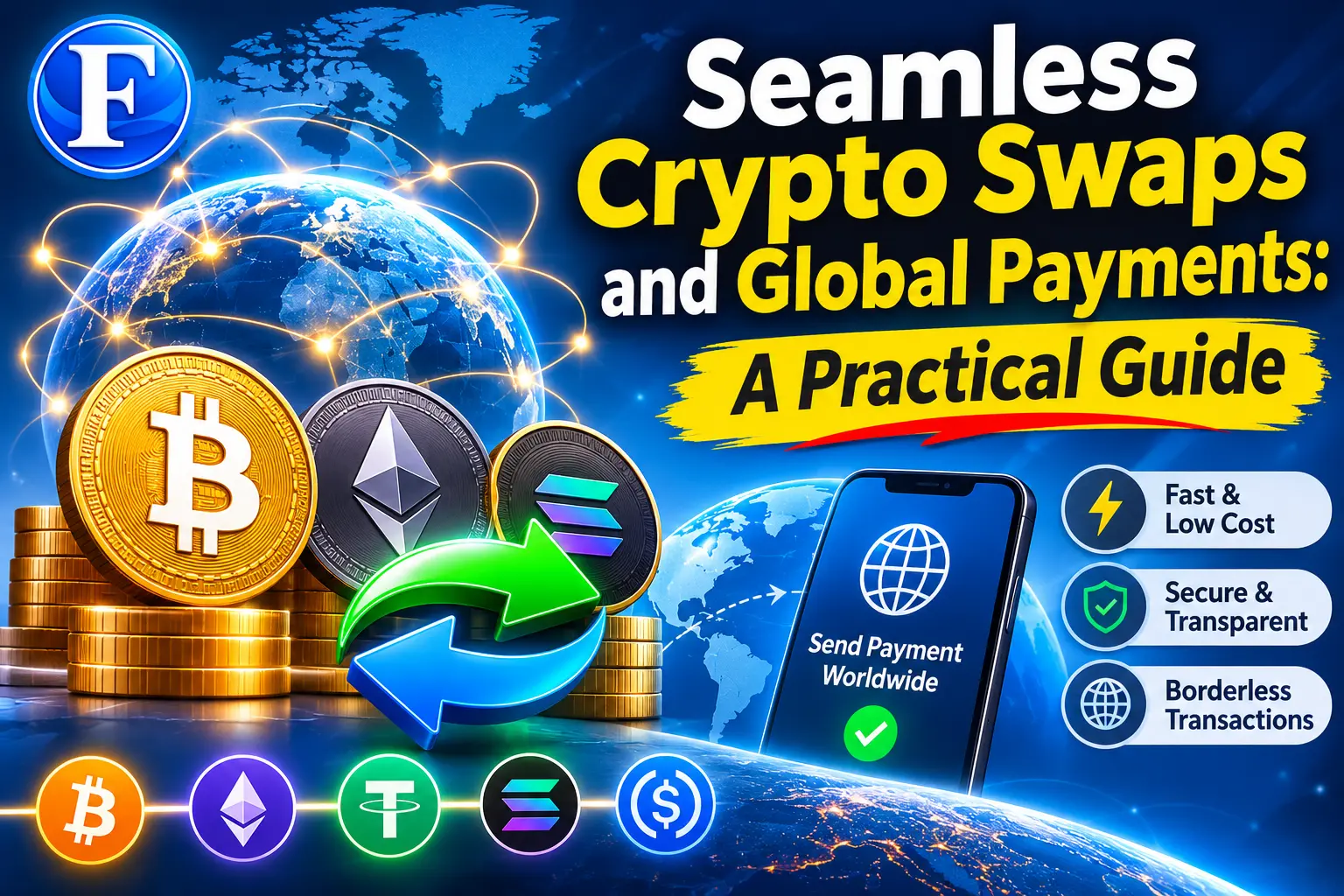
Sending money across borders has long meant high fees, slow transfers, and a lot of paperwork. Crypto swaps and stablecoin payments promise something faster and cheaper, and a growing number of apps and platforms now offer them. But the same speed that makes these tools attractive also makes mistakes costly. This guide explains how crypto swaps and global payments work, the main types of providers, and how to use them safely.
Key Takeaways
- A crypto swap exchanges one digital asset for another directly, without first converting to regular (fiat) money.
- Stablecoins such as USDC and USDT are widely used for cross-border payments because their value is tied to a currency like the US dollar.
- Providers fall into a few groups: wallets, payment cards and apps, on/off-ramp platforms, and business payment infrastructure. Each suits a different need.
- Total cost depends on more than the headline fee: network fees, exchange rates, spreads, and withdrawal charges all matter.
- Transactions are usually irreversible, so testing with a small amount first is one of the best habits you can build.
What Is a Crypto Swap?
A crypto swap is a direct exchange of one digital asset for another, for example trading Ethereum for a stablecoin. Instead of selling your coin for cash and then buying another coin, the swap does both in one step.
Swaps can happen in different places:
- Centralized exchanges, where a company holds your funds and matches your trade.
- Decentralized exchanges (DEXs), where smart contracts and liquidity pools handle the trade and you keep control of your wallet.
- Wallet and payment apps, which often include a built-in swap feature that routes your trade through one of the above behind the scenes.
Some swap tools advertise fixed quotes, meaning the price you see is the price you get. Others use market prices that can move while your transaction is processing. This difference is called slippage, and it is worth checking before you confirm.
How Do Global Crypto Payments Work?
A typical cross-border crypto payment follows a simple path:
- On-ramp: the sender converts local money into a digital asset, often a stablecoin.
- Transfer: the asset moves across a blockchain network, usually within minutes.
- Swap (optional): if needed, the receiver swaps it into another token.
- Off-ramp: the receiver converts it into local money, withdraws cash, or spends it by card.
Compared with a traditional bank transfer, which may pass through several intermediary banks, this route can be faster and sometimes cheaper. The catch is that the on-ramp and off-ramp steps are where most fees, limits, and verification checks appear.
Why Stablecoins Matter
Prices of coins like Bitcoin can change sharply within hours. That is a problem if you are paying a supplier or sending money to family. Stablecoins try to solve this by tracking the value of a currency, most commonly the US dollar.
Benefits people often cite include fast settlement, lower intermediary costs, and availability outside banking hours. Risks include the issuer’s reserves, possible loss of the peg, and changing regulation. Not all stablecoins are equally trustworthy, so it pays to understand who issues the one you use.
Types of Providers You Will Come Across
The market is crowded, so it helps to group providers by what they do. The categories below describe common models, not recommendations.
| Type | What it does | Often suits |
|---|---|---|
| Self-custody wallets | You hold your own keys and can send, receive, and swap from one app | Users who want control and are comfortable managing security |
| Stablecoin payment apps and cards | Let you hold digital dollars, spend by card, and withdraw at ATMs in supported countries | Everyday spending and travel |
| On/off-ramp platforms | Convert between crypto and local currency, often through APIs for businesses | Apps and merchants adding crypto features |
| Swap-focused services | Specialize in token-to-token trades, sometimes with fixed quotes | Moving between assets quickly |
| Business payment infrastructure | Settle cross-border payments for importers, exporters, and companies | Companies paying suppliers abroad |
| Crypto payment gateways | Let merchants accept crypto payments online | Online stores and service providers |
Many well-known names combine several of these functions. Always read what a specific provider actually offers in your country, since supported regions, currencies, and features differ.
Custodial vs Non-Custodial: Understanding the Trade-Off
This is one of the most important choices you will make.
- Custodial services hold your funds for you. They are usually easier to use and may offer account recovery, but you depend on the company. If it freezes your account or fails, you can lose access.
- Non-custodial (self-custody) wallets give you the private keys. No one can freeze your funds, but no one can recover them if you lose your recovery phrase either.
Neither option is automatically better. Beginners often feel safer starting with a regulated, custodial service for small amounts, then learning self-custody gradually. Experienced users may prefer to hold their own keys for larger balances.
Understanding the Real Cost
A low advertised fee does not always mean a low total cost. Check each of these:
- Service or platform fee: the percentage the provider charges.
- Spread: the gap between the market price and the price you are offered.
- Network (gas) fees: paid to the blockchain, and they rise when the network is busy.
- On-ramp and off-ramp charges: card, bank transfer, or withdrawal fees.
- Exchange rate for local currency: a weak rate can cost more than any listed fee.
To compare fairly, run the same test on two providers: start with the same amount, finish with the same destination, and compare how much actually arrives.
How to Make a Safe First Swap or Payment
- Define your goal. Decide whether you need a swap, a transfer, a card, or a business payment solution.
- Check the provider’s background. Look for company details, a clear support channel, and independent reviews, not just testimonials on its own site.
- Confirm availability in your country. Supported regions and payment methods vary, and rules change.
- Secure your account. Turn on two-factor authentication and use a strong, unique password.
- Protect your recovery phrase. Write it down offline and never share it or photograph it.
- Send a small test first. Confirm speed, fees, and that the funds arrive correctly.
- Double-check the network and address. Sending a token on the wrong network can lead to permanent loss.
- Keep records. Save transaction IDs and receipts for tax and dispute purposes.
Common Mistakes and Scams to Avoid
- Choosing the wrong network. The same token can exist on several blockchains, and addresses are not interchangeable.
- Ignoring fees until the end. Check the final amount before you confirm, not after.
- Falling for impersonators. Fake support accounts and cloned websites target people who post complaints. Only use contact details from the official site or app.
- Sharing your seed phrase. No genuine provider will ever ask for it.
- Chasing “guaranteed” returns. Promises of risk-free profit are a classic warning sign.
- Approving unknown contracts. On decentralized platforms, a careless approval can let a malicious contract drain your wallet.
- Using one provider for everything. Spreading funds and keeping a backup option limits the damage if one service has problems.
Before you trust any platform, search for its name together with words like “withdrawal problems” or “complaints.” A few unhappy users are normal, but patterns of unresolved withdrawals deserve attention.
Regulation and Legal Considerations
Crypto rules differ widely between countries and are still changing. Some places welcome regulated providers, while others restrict or limit certain activities. Many platforms also require identity verification (KYC) before you can convert money or withdraw, and they may limit service in some regions.
Before you send or receive meaningful amounts, check the current rules in your country, understand any tax obligations, and use only services that are allowed where you live. Laws and provider policies change, so rely on official sources and up-to-date information rather than old articles.
Frequently Asked Questions
Are crypto swaps safe?
They can be, but safety depends on the platform, the network, and your own habits. Use reputable providers, protect your keys, and start with a small amount.
Are crypto payments cheaper than bank transfers?
Sometimes. Savings depend on the route, network fees, and on/off-ramp costs. Compare the final amount received, not just the headline fee.
Can transactions be reversed?
Usually not. Blockchain transfers are typically final, which is why checking addresses and networks matters.
What is slippage?
Slippage is the difference between the price you expected and the price you actually received. Fixed-quote swaps aim to remove it, while market-price swaps can experience it.
Do I need a wallet to swap crypto?
Not always. Custodial platforms can handle crypto swap inside your account, while decentralized swaps usually require a wallet you control.
What happens if I lose my recovery phrase?
With a self-custody wallet, funds are generally unrecoverable. With a custodial service, you may be able to recover your account through the provider.
Conclusion
Crypto swaps and stablecoin payments can make international money transfers faster and more flexible, but they work best for people who understand the trade-offs. Choose a provider that fits your goal, compare the total cost, secure your accounts, check the rules where you live, and always test with a small amount first. Taking these simple steps matters more than chasing the lowest advertised fee.
Disclaimer: This article is for general information only and is not financial, legal, or tax advice. Cryptocurrency carries risk, including loss of funds. Provider features, fees, and regulations change, so verify details on official websites before you act.