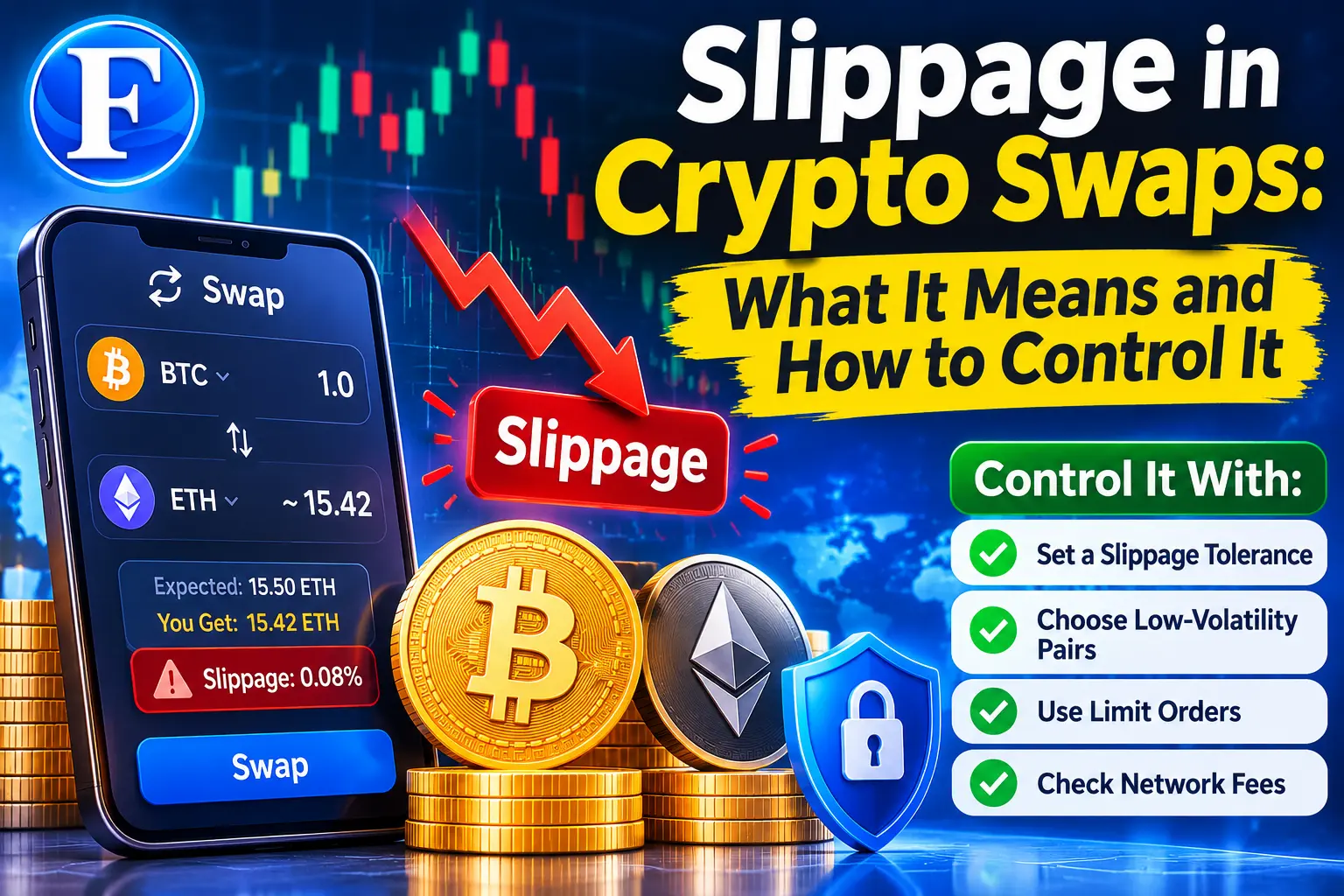
You open a swap screen, see a price, tap confirm, and receive slightly less than you expected. That gap has a name: slippage. It affects almost every crypto trader sooner or later, and it can quietly eat into your money if you do not understand it. This guide explains what slippage is, why it happens, and the practical steps you can take to keep it under control.
Key Takeaways
- Slippage is the difference between the price you expected when you placed a trade and the price at which it actually executed.
- It can be negative (you get less than quoted) or positive (you get more), though traders mostly worry about the negative kind.
- Common causes include price volatility, thin liquidity, large order sizes, network delays, and bots that target pending trades.
- You can reduce it by setting a slippage tolerance, trading liquid pairs, splitting large orders, and checking the minimum amount you will receive.
- A very high tolerance can protect a trade from failing but can also leave you open to a much worse price, so it is a trade-off.
What Is Slippage in Crypto?
Slippage is the gap between the expected price of a trade and the executed price. It is usually shown as a percentage:
Slippage % = (Executed price − Expected price) ÷ Expected price × 100
For example, suppose you expect to swap for a token at a price of 100 and the trade fills at 99. If you are buying, that is a better price for you (positive slippage). If you are selling and the price is 99 instead of 100, that is worse for you (negative slippage). Whether the same price move helps or hurts depends on which side of the trade you are on.
Slippage is not a fee charged by the platform. It is a result of how markets move and how trades are matched, and it exists on both centralized and decentralized platforms.
Why Does Slippage Happen?
1. Market volatility
Prices can change within seconds. If the market moves between the moment you see a quote and the moment your trade is processed, the price you receive will differ from the one you saw.
2. Low liquidity
Liquidity describes how easily you can buy or sell without moving the price. On a decentralized exchange (DEX) that uses an automated market maker, trades happen against a pool of tokens. In a small pool, even a modest trade can shift the price noticeably. Less popular tokens and new tokens usually have thin liquidity, which is why they often show higher slippage.
3. Large order size
A bigger trade uses up more of the available supply at the best price. On an order-book exchange, your order may have to fill against progressively worse offers. On a DEX, a large swap pushes the pool’s price curve further against you.
4. Network congestion and delays
On a blockchain, your swap waits to be included in a block. When the network is busy or the fee you offered is low, the wait is longer, and the price has more time to change before your trade completes.
5. Bots targeting pending trades
On public blockchains, pending transactions are visible. Some bots exploit this by placing trades just before and after yours to move the price against you, often called a sandwich attack. This is part of a wider issue known as maximal extractable value (MEV). The higher the slippage tolerance you set, the more room such bots have to profit from your trade.
Slippage vs Price Impact: What Is the Difference?
These two terms are often mixed up, but they are not the same.
- Price impact is how much your own trade moves the price because of its size relative to the available liquidity. Many swap screens show it before you confirm.
- Slippage is the total difference between the quoted price and the final price, including price impact and any market movement that happens while your transaction is pending.
In short, price impact is something you can estimate in advance, while the extra slippage from market movement is harder to predict.
What Is Slippage Tolerance?
Most swap interfaces let you set a slippage tolerance. This is the maximum price difference you are willing to accept. If the price moves beyond your limit, the transaction fails instead of completing at a worse price.
Here is how it plays out:
- Tolerance too low: your swap may fail repeatedly, especially with volatile tokens, and you may still pay network fees for the failed attempts.
- Tolerance too high: your swap is more likely to go through, but you may receive far less than you intended, and you become an easier target for sandwich bots.
A common rule of thumb is to use a small tolerance for stable and highly liquid pairs, and a somewhat higher one for volatile or low-liquidity tokens. The right number depends on the token, the pool size, and current market conditions, so treat any figure you read online as a starting point, not a rule.
How to Control and Reduce Slippage
- Set a sensible tolerance. Match it to the asset. Stablecoin-to-stablecoin swaps rarely need more than a very small margin, while a volatile new token may need more.
- Check the “minimum received” amount. Most platforms show the least you will get at your chosen tolerance. Read it before you sign.
- Trade liquid pairs. Look at pool size, trading volume, or order-book depth. Deeper liquidity generally means less slippage.
- Split large trades. Breaking one big order into several smaller ones reduces your own impact on the price.
- Use limit orders where available. On exchanges that support them, a limit order lets you set the exact price you will accept, instead of taking whatever the market gives.
- Try a DEX aggregator. Aggregators compare several liquidity sources and may route your trade across them to find a better overall rate.
- Pick your timing. Trading during busy, high-volume periods can mean better liquidity, while moments of sharp volatility or heavy network congestion can mean worse fills.
- Consider fixed-quote options. Some services offer quotes that are locked in for a short time, which can remove slippage on that trade, though other costs may still apply.
- Mind network fees. A higher network fee can speed up confirmation and shorten the time the price has to move.
- Use a trusted interface. Fake swap sites and cloned apps are a real risk, so always use the official app or a verified link.
Slippage on Centralized vs Decentralized Platforms
| Feature | Centralized exchange (CEX) | Decentralized exchange (DEX) |
|---|---|---|
| How trades match | Order book | Liquidity pools or routed liquidity |
| Main cause of slippage | Market orders against thin order books | Pool size, price curve, and pending time |
| Tools to control it | Limit orders, order size | Slippage tolerance, routing, trade splitting |
| Extra risks | Platform and custody risk | Sandwich bots, failed-transaction fees |
Slippage and Meme Coins
People often search for the “best slippage for meme coins,” and it is easy to see why. These tokens tend to have thin liquidity, sharp price swings, and sometimes built-in transfer taxes that require a higher tolerance just to complete a trade. That combination makes them expensive to trade and attractive to bots. There is no safe number here. If a token needs a very high tolerance to trade at all, that is a warning sign that the liquidity is poor or that the token’s design is unusual, so research it before you risk money.
Common Mistakes to Avoid
- Setting tolerance very high to force a swap through. This can lead to a much worse price than you intended.
- Ignoring price impact warnings. If the screen shows a large impact, the pool may be too small for your trade.
- Retrying failed swaps repeatedly. Each failed attempt can cost network fees.
- Forgetting about fees. Slippage is only one cost. Platform fees, network fees, and spreads add to it.
- Trading unknown tokens in a hurry. Low-liquidity and newly launched tokens combine high slippage with higher scam risk.
- Using unofficial links. Always check the website address and avoid links from unknown messages.
Frequently Asked Questions
Is slippage the same as a fee?
No. A fee is a charge from a platform or network. Slippage is a price difference caused by market movement and liquidity.
Can slippage ever be good for me?
Yes. If the price moves in your favor before the trade executes, you can receive a better price than quoted. This is called positive slippage.
Why did my swap fail with a slippage error?
The price moved beyond your tolerance before the transaction was confirmed, so the platform cancelled the swap to protect you. You may still be charged a network fee.
What slippage tolerance should I use?
There is no single answer. Use a low setting for liquid and stable pairs, and be cautious when a volatile token demands a high one.
Does slippage happen on centralized exchanges too?
Yes. Market orders on an exchange fill at the best available prices in the order book, which may be worse than the last price you saw, especially for large orders or thin markets.
How can I avoid sandwich attacks?
Keep your tolerance as low as practical, avoid trading in very thin pools, and consider tools or wallets that offer protection against front-running.
Conclusion
Slippage is a normal part of trading crypto, but it does not have to be a surprise. Understand what causes it, check the price impact and the minimum amount you will receive, trade liquid assets when you can, and set a tolerance that fits the situation instead of a number copied from the internet. A few seconds of checking before you confirm can save you real money.
Disclaimer: This article is for general education only and is not financial advice. Crypto trading carries risk, including loss of funds. Platform features and typical settings change, so verify details on the official site or app you use.SecuroomAi https://securoomai.es/